
March 31, 2026
When it comes to painting a house in Lenox Hill, New York, the project never starts with a blank slate and four straightforward walls. You’ve got artwork to navigate around, built-in cabinets, intricate trim, radiators, narrow hallways, big windows, older plaster, multiple doorways plus rooms that need to remain functional while the work is being done. And let’s be real, even just moving furniture around and figuring out which room to paint first can really make or break the whole project.
That was one of the biggest takeaways from our recent house painting gig in Lenox Hill.
Instead of starting out by asking “what color should we use?”, we found ourselves thinking about three separate “maps” of the home: how people move around it, how daylight moves through it, and how heat moves through it.
And believe it or not, those three things can tell you a whole lot about how to prep and paint an interior.
The Hard-Won Lesson: Don’t Plan Colors Before You’ve Mapped Out How People Move Through Your Home
Take a walk through your house, but don’t look at paint colors. Just pay attention to where people interact with the walls the most.
The wall next to the front door.
The door casings.
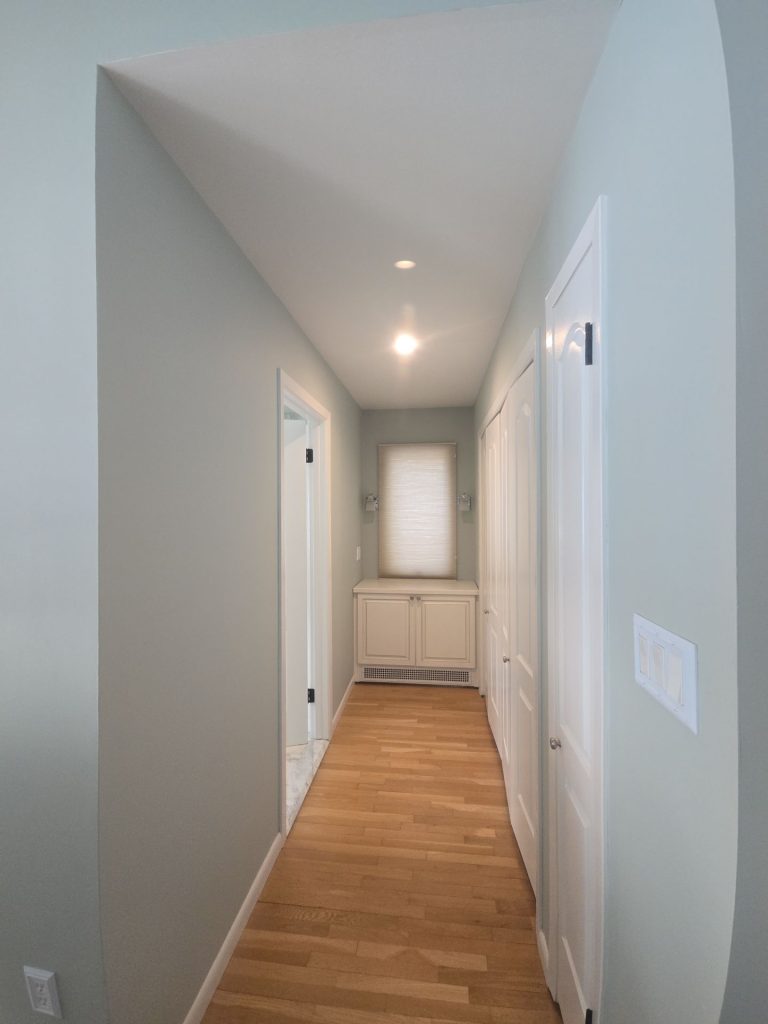
The narrow section of the hallway that everyone crowds into.
The corner near the kitchen.
The wall in the bedroom right next to the frequently used light switch.
Closet doors.
The baseboards where shoes, bags, vacuums, and furniture keep bumping into things.
Those surfaces might be more important to your painting plan than the biggest wall in the room.
Why? Because paint just doesn’t wear evenly. A beautiful living room wall can stay looking great for years, while the trim around a heavily used doorway starts looking tired a lot sooner.
Which is exactly why our recent Lenox Hill project was a real reminder: paint according to how your home is actually lived in – not just according to how the floor plan looks.
The Wall Behind the Sofa & The Hallway Wall Don’t Have the Same Job
Imagine two walls painted the same color. One’s behind a sofa and is hardly ever touched.
The other’s part of the narrow passage between the kitchen and front entry.
Technically, they are both painted walls. Functionally, though, they are totally different surfaces.
The hallway wall might get brushed against every day. Bags may get caught on it, furniture might occasionally bump it, and people may reach in for the light switch.
The wall behind the sofa, on the other hand, gets none of that.
That doesn’t mean they have to be painted different colors – but it does mean you should consider things like durability, sheen, surface prep & expectations differently.
Because in compact New York apartments, these small differences can really add up because high-traffic areas can end up being a pretty big chunk of what you see in your home.
#Teaching Moment #2: Build a Light Map
The time of day & direction of the windows in a Lenox Hill interior can make it change dramatically.
A room that’s facing one direction can feel bright & warm in the morning but then be a lot cooler by the afternoon. Another room that’s farther away from the windows might be relying on artificial light.
This means that one color can look like several different colors in the same house.
Take some time to observe the room in different lighting conditions.
What does it look like in the morning?
At lunchtime?
Under overcast light?
Right after sunset with just lamps & ceiling fixtures?
This is especially important for whites, off-whites, grays & muted colors since their undertones can become much more noticeable as the light changes.
Looking at a sample in a showroom just isn’t enough.
The room itself should be your final colour test.
Manhattan Window Light Can Change Your Decision
Urban light is different from what you get in the suburbs.
The view outside your window – whether it’s another building, masonry, glass, trees or a shaded courtyard – will affect how bright & what kind of light is entering the room.
A neutral that would have worked just fine in another home might look cooler in one Lenox Hill room and warmer in another.
That’s why we always prefer to evaluate color in the actual space instead of assuming a certain color will behave the same way everywhere.
The right question isnt “is this a good paint color?” it should be “is this a good paint color in this room, with this light, next to these materials”. That’s a lot more useful.
#Don’t Pick Wall Color Without Looking at the Floors
When selecting paint colours, people often completely neglect flooring – which is one of the biggest uninterrupted finishes in a room.
Warm wood can make a grey wall look cooler.
Dark flooring can make a light neutral wall look brighter.
Stone, tile, rugs, cabinetry, countertops, and big furniture pieces can all influence how a wall colour looks.
This was another thing we learned from our recent Lenox Hill project: the paint is never viewed by itself – it’s always sitting beside something.
Flooring, woodwork, and cabinetry generally can’t be changed easily, so it makes sense to consider them first when choosing a colour.# Teaching Moment #3: Make a Heat Map
March 31 can create a bit of a pickle for interior painters in New York City.
Spring is supposed to be in the air on the calendar, but the building might still be telling a different story.
That’s because New York City’s official heating season doesn’t wrap up until May 31, and residential building owners have to meet certain indoor temperature requirements during that time.
This makes a difference when it comes to an interior painting project, because heating systems are still going to be kicking in from time to time.
In older Manhattan homes, radiators and heating systems can create some seriously warm hotspots – even when the rest of the room feels just fine.
So before you start painting, you need to think about where the heat is actually coming from.
A wall a few feet away from a radiator isn’t going to be in the same shape as the wall right behind it – and that’s just another reason why pro painters should be paying attention to the actual conditions of a room, rather than just treating every wall like they’re all the same.
The Area Behind a Radiator Deserves A Closer Look
Radiators are one of those classic New York painting situations where access and prep matter just as much as color.
Over time, walls near heating equipment can end up with discoloration, dust buildup, old touch-ups that don’t quite match, or hard-to-reach areas that got skipped the last time around.
Painting just what you can see can leave the room looking unfinished.
Where you can get access, you should take a good hard look at these areas, along with the surrounding wall so the finished paint job looks like it’s all one piece.
Same idea applies behind big furniture, around built-ins, and inside those tight little nooks and crannies.
If you do end up being able to see a surface when you move the furniture around, you don’t want to discover that the old paint job stopped six inches short of the cabinet.
The Fourth Map: Where Has This Wall Been Repaired Before?
If traffic, light, and heat tell us how a room behaves, old patches tell us its history.
Lenox Hill homes can be real patchwork quilts, with walls that’ve been tweaked and modified over the years.
Artwork gets moved, televisions get hung – or moved again, shelves get swapped out, electrical work gets done, curtain hardware gets updated… and on and on.
Small cracks get fixed, and people try to fill in holes and touch up paint – and before you know it, a wall can have a whole bunch of repairs inside it – even if it still looks pretty okay to the naked eye.
Fresh paint can even make poorly blended repairs stand out more, because the new finish is going to catch the light and show up all the imperfections.
That’s why prep is so important.
It’s not just about filling a hole – it’s about making that repaired area just disappear when the wall gets painted.
Older New York Homes Require An Extra Safety Question
Before you start sanding or messing with old paint in an older residence, you need to think about the age and history of the place.
The Feds have rules about disturbing old paint in pre-1978 buildings – and New York City’s got some extra rules too, especially for older buildings.
That doesn’t mean every old wall’s got lead paint, but it does mean you need to figure out the right prep method before you start messing with old coatings.
For painters, it’s not just about getting a smooth wall – it’s about doing the job safely and right.
Why “Just Touch It Up” Often Doesn’t Work
Touching up a paint job sounds easy enough – just cover the mark, done.
But walls age, and the old paint on the wall may have changed over time – it might have faded a bit, or gotten a weird sheen from all the cleaning… and even if you’re using paint from the same can, it might not behave the same way as the paint already on the wall.
And even if the color is supposed to be the same, a small repair can sometimes show up like a bullseye when you look at it from an angle.
This is especially true on walls with lots of direct sunlight.
If you’ve got a lot of little repairs scattered around, it might be better to just repaint the whole wall instead of trying to touch each one up separately – and that decision should be made after you’ve seen the wall with all the lights on.
Trim Can Transform A Lenox Hill Interior Without A Whole New Paint Color
A lot of homeowners think a big transformation has to come from changing the wall color – but that’s not necessarily true.
In a room with a lot of trim – doors, casings, baseboards, crown molding, built-ins, or decorative millwork – updating that trim can have a huge impact.
Clean, consistent trim creates sharper lines in a room, makes doorways stand out more, and visually separates the walls from the floor.
Windows even look cleaner.
Architectural details that used to blend into the background start to pop again.
This is especially useful when you’re already happy with your general color palette and you just want the room to feel like it’s been refreshed.
A lot of the time, the best painting project isn’t a total redesign… it’s just a little tweak.
The Manhattan Logistics Lesson
Painting in Lenox Hill has a whole different dynamic than painting in a suburban empty house – because in a Manhattan residence, every square foot counts.
You need to think about sequencing – getting the right things out of the way before you start painting.
Furniture needs to go somewhere, residents still need access to their bedrooms or bathrooms… it’s a tight squeeze.Hallways can’t just remain blocked , you know. There’s a real need to get things organized around here.
Materials need to get sorted out.
And a little thing like common courtesy when it comes to building access and shared areas would be nice.
That means we might actually need to get a bit more strategic with the painting plan – maybe break the home down into sections rather than just going whole hog and disrupting everything all at once.
Finish one area off, get it looking good.
Then get it back to a point where people can use it again.
And then carefully move on to the next one.
For people who are living in the house, you know, good logistics can make all the difference. It really can make the project a heck of a lot less intrusive.
March 31 Is a Good Time to Take Stock of Your Interiors
By the time the end of March rolls around, New Yorkers are starting to wake up to their interiors in a whole new way.
Daylight is getting longer.
Windows are becoming a lot more visible.
People start spring cleaning and shuffling furniture around.
And suddenly all those little imperfections that were invisible in the winter – wall marks, old patches, tired trim, the whole works – are a lot easier to spot.
Which makes early spring a pretty good time to take a look at your interiors, even if it isn’t because every room needs to get repainted.
But it is because the stronger daylight gives you a great opportunity to figure out what really does need some attention.
Take a squint at the walls from an angle, don’t just stare straight at ’em.
The natural light can reveal all sorts of imperfections that overhead lighting would otherwise hide.
What We Learnt from a Recent Job in Lenox Hill
What we really learned from a recent house painting project we did in Lenox Hill, New York, wasnt so much about choosing a trendy color.
But rather it was about taking the time to really think about the room before you start messing around with it.
Where do people actually walk?
Where do hands touch surfaces?
Where is the daylight coming from?
Which surfaces get the heat?
Where have people tried to fix things in the past?
What are the trim details that really add to the place?
When youve got those questions knocked out, decisions about how to prep the place, what color to go with, and all that stuff become a heck of a lot easier.
That makes way more sense than just picking a swatch of paint and then trying to make the house fit around it.
Planning for a House Paint Job in Lenox Hill, NY?
If you’re looking to give a single room a refresh, or give your whole Lenox Hill home a coat of paint, the key is to take some time to get to know how your home actually gets used before you decide what needs paint.
Watch the traffic flow.
See where the daylight is coming from.
Notice which surfaces get the heat in winter.
Take a close look at old repairs.
Check the doors and trim.
Then build your painting plan around what youve observed.
At CET Painting, we do house painting in Lenox Hill and all over NYC with a different mindset – we dont just see it as a colour change. We see it as an opportunity to really understand the surfaces, the architecture, and how people live in the space.
Because in any New York home – every square foot has a job.
The paint job should be done with that in mind.