
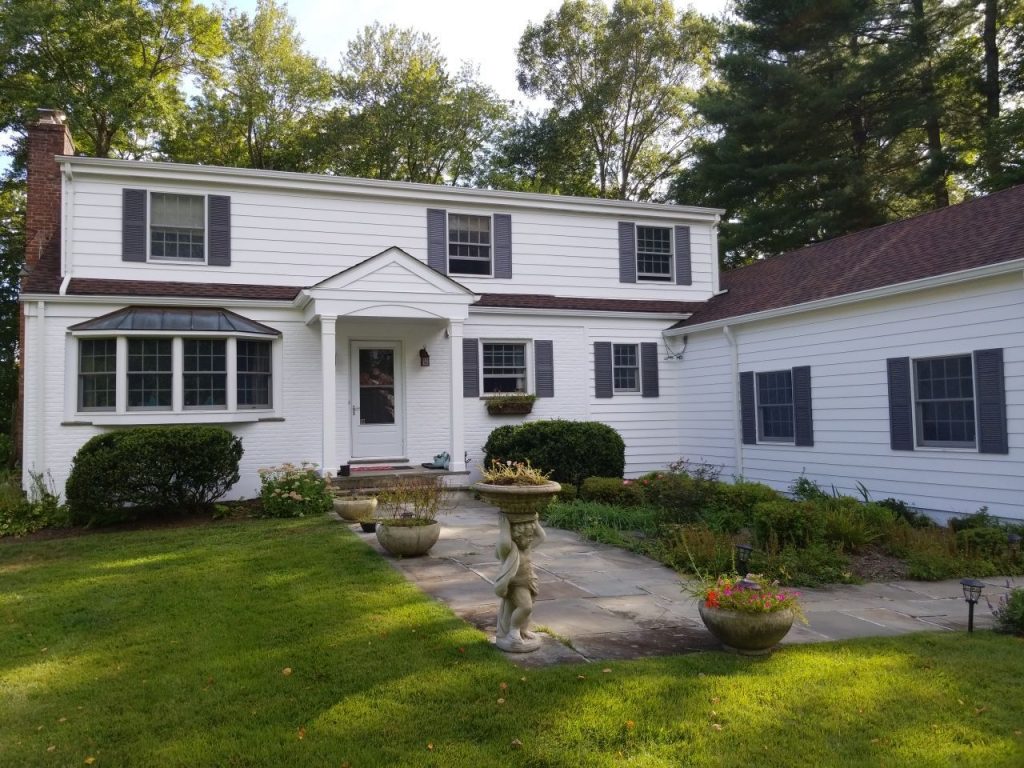
House Painting in Greenvale, NY: A Late-Spring Painting Lesson
One of the easiest mistakes to make when planning an exterior painting project is thinking your house is one big uniform exterior.
It’s not.
A recent house painting project in Greenvale, New York came as a useful reminder that homeowners often overlook: the front, back and sides of the same home can age at completely different rates. Sunlight, shade and weather all affect how paint and exterior surfaces behave.
Which is especially true in late May. Greenvale is situated in Nassau County on Long Island, where established neighborhoods and mature landscaping can create dramatically different conditions around your property in a heartbeat.
So our Greenvale homeowners lesson for this spring is simple: before deciding your house “needs painting” take a walk around all four sides of your property and take a good hard look. What you learn may change the painting plan entirely.
The Side of the House You Rarely See May Need the Most Attention
Homeowners typically only ever look at their exterior from the driveway.
The front looks faded so you assume that’s the main problem. Or the front still looks good so you assume the paint has a few more years left to go.
But neither of those conclusions tells the whole story either.
Take a walk around to the side of the home that gets less direct sunlight and you may see a completely different surface. Paint might have plenty of color but be showing dirt, organic buildup or moisture-related discoloration. Or it could be the other way around – stronger sunlight can cause one side to be faded, chalky or dry.
Then look at areas underneath gutters, roof overhangs, trees and dense landscaping. Those bits create their own little micro-environments.
That’s why a pro should do an exterior painting assessment one elevation at a time, not just for the whole house.
Greenvale Homes Can Create Their Own Personal Weather Conditions
You don’t need a high-tech weather station to spot this happening.
Stand beside your home on a sunny May afternoon and you’ll see the difference for yourself. One wall may feel warm and dry, while 20 feet away a wall behind some mature shrubs is still cool to the touch, and another section beneath a tree canopy is getting filtered sunlight for only a few hours a day.
Those conditions affect how quickly surfaces dry after rain, how long morning moisture lingers and how rapidly a previous coating breaks down.
It also explains the common question homeowners ask: “why is the paint failing here when the other side looks fine?”
The answer is usually exposure. A house doesn’t weather evenly because weather doesn’t reach every part of the house evenly.
The Late-May Paint Inspection We Recommend in Greenvale
Late May is a really useful time to do this inspection.
Winter is behind us, spring moisture has shown up some vulnerable areas, and the stronger sunlight makes faded or uneven surfaces a lot easier to spot.
Before summer gets into full swing walk around the property and compare these four things:
- Color: is one elevation a lot more faded than another?
- Surface: do you see peeling, cracking, chalking or exposed material?
- Moisture patterns: are shaded areas staying darker or showing organic buildup?
- Transitions: take a close look around windows, doors, trim, gutters, joints and where two different materials meet.
You’re not just looking for ugly paint. You’re trying to figure out why that section of the house aged differently.
Which matters a whole lot.
Painting Over the Problem Won’t Fix it Either
Imagine you notice peeling paint beneath a window.
The quickest response is to scrape it and repaint it.
Sometimes that is just what is needed.
But first, ask why the coating failed in the first place.
If water is repeatedly getting to that area because of a problem with the gutter, flashing, caulk or drainage, then repainting alone might just give you a beautiful fix that will eventually fail again.
The same goes for persistent discoloration on a heavily shaded elevation. You might need to clean it and get it properly dry before you can coat it, whereas a sun-beaten section might need more intensive prep than a protected wall that is still in great condition.
Good exterior painting starts with figuring out what’s going on.
The paintbrush comes later.
Surface Preparation Should Reflect the Problem
And that is where exterior painting becomes more than just choosing a colour.
Suppose three sides of a Greenvale home are in pretty good condition while the fourth has peeling material and gets a lot more weather exposure.
You might be tempted to treat all four surfaces the same.
But that would be a mistake.
The deteriorated elevation may need a heavier scrape, more sanding, some spot priming or repairs. Another area may just need a good clean. Certain trim sections may need some caulking done, while sound areas should not be messed around with just because another part of the house needs a lot of prep.
That’s why professional prep should be responding to what’s actually happening on each surface.
Uniform paint doesn’t require uniform prep.
That’s one of the most important lessons homeowners can take from this type of project.
Don’t Let New Spring Landscaping Hide Exterior Problems
And finally, there’s another Greenvale-specific consideration worth keeping an eye on in late May: your landscaping.**By This Point in Spring, Shrubs and Trees Have Really Started to Expand & Leave Siding & Trim Exposed
Beautiful landscaping is a real asset for any home , but it can cause problems when it starts growing right up against painted surfaces. Not only is that going to make it harder to see if you have any issues with your paint, but it can also prevent air from circulating around your house.
Before you even think about painting, you need to be able to get to those areas of your house to clean, prep and apply the new paint.
And no, this doesn’t mean tearing out all of that beautiful established landscaping.
It just means taking a hard look at the wall behind that hedge the same way you look at the wall facing the driveway.
Sometimes even more so.
Why Exterior Color Can Look so Different Around the Same House
Exposure really does matter when you’re picking a new exterior color.
Take a paint sample and put it up on the bright front of your house. It’s going to look one way. But move it to the shady side wall and it’s going to look completely different.
Warm neutrals can actually look cooler when they’re in the shade. Deeper colors look darker when they’re in the shade. Whites may end up picking up some of the reflection off that greenery. And then there’s the sunlight which can make a color look lighter than you thought it would.
That’s why we like to evaluate exterior samples in more than one place.
Put the sample where the morning sun hits it. Then put it on the shady side. And then come back to it later in the day. Not to change the paint, but to get a good idea of what it’s actually going to look like when you paint the whole house.
The Most Expensive Painting Mistake Often Happens Before You Even Start Painting
Homeowners spend a lot of time comparing paint brands and colours.
And those decisions do matter.
But the thing is, the lifespan of your exterior paint job is going to be a lot more about what you do before you even apply the top coat.
If you leave dirt underneath the paint, the new coat isn’t going to stick properly.
If you just cover up loose paint with a new coat, the new paint is still going to be relying on the old paint for its surface. Which is probably not stable.
And if you’ve got damaged surfaces that you’re just covering over, it might make them look better for a little while but you’ve not actually fixed the problem.
And worst of all if you’ve got moisture trapped underneath the paint, even the best paint job in the world is going to start to crack and fall apart pretty quickly.
Preparation isn’t the dull bit of painting the house – it’s the project. Painting is the final bit.
A Better Question for Homeowners in Greenvale
Instead of asking yourself “Do I need to paint the whole house this year?”
Ask “Which bits of my house need some TLC this year?”
That question can actually lead to a lot better decision.
You might find out that the whole house needs a new coat of paint.
You might find out that the main body of the house is fine but the trim needs some maintenance.
Or you might identify a potential problem now before it becomes a major issue down the line.
Spring is actually a great time to make that assessment before summer really gets going.
What We Learned From Painting Houses in Greenvale
The real lesson here isn’t actually about the paint.
It’s about paying attention to the house itself.
Your house is different on every side – some bits get a lot of sunlight, some bits get a lot of moisture, and so on.
You need to inspect them all the same way.
Our approach to painting houses in Greenvale NY is about checking what the house needs first, not about just going for a colour.
When you focus on getting the preparation right, it means the finished job is going to last.
And when you’re spending good money on your house, that long term performance is a lot more important than just how it looks for the first few months.
Planning a Painting Job in Greenvale, New York?
If your house is one of those places where the front and back look totally different, don’t assume you have a weird paint job.
It might just be that your house is actually weathering normally.
C.E.T. Painting provides professional interior & exterior painting services in Greenvale and throughout Nassau County. We put a big emphasis on careful prep, the right finish for the job, and a surface treatment that actually makes your house last.
And if you want to get the right colour for your house, let us help figure out what your exterior is actually telling you.